Wednesday, June 26, 2019

Star Wars Roleplaying in Galaxy's Edge

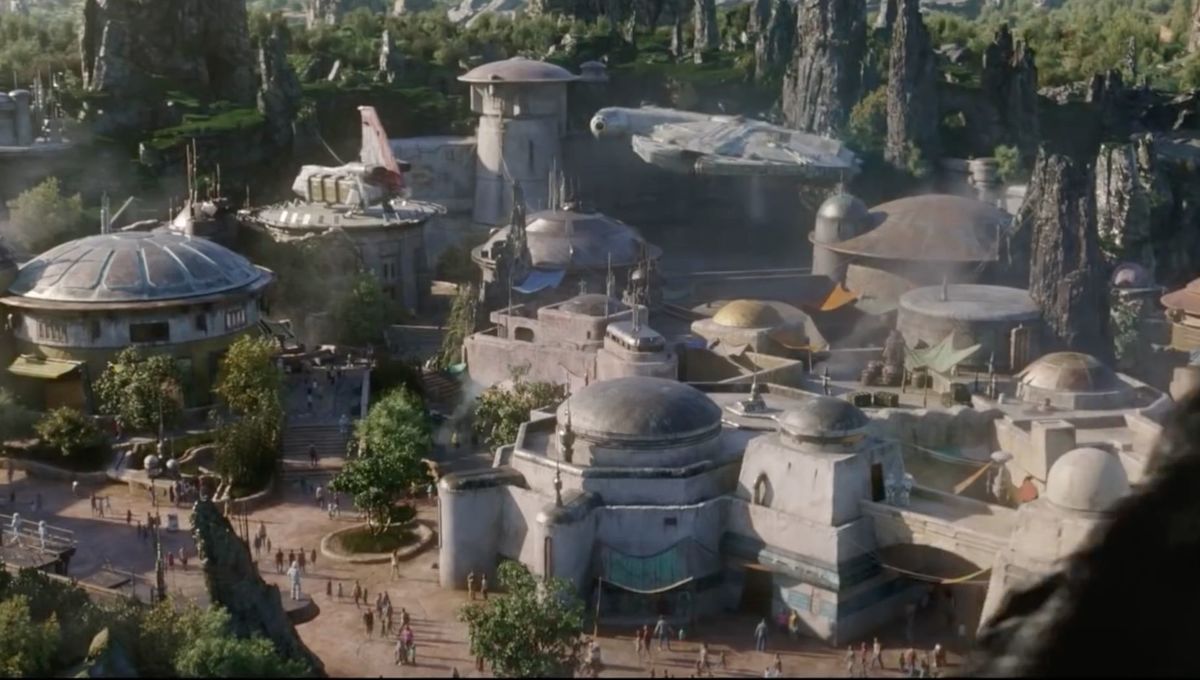
            The setting for the new Galaxy’s Edge parks at Disneyland and Disney World is Black Spire Outpost. It’s a small settlement on the planet Batuu, at the edge of the Outer Rim and near where the known galaxy meets Unknown Space and Wild Space. Black Spire outpost is a creation of Timothy Zahn in his novel Thrawn Alliances, which is worth the read even if you don’t care about its connection to Galaxy’s Edge. The novel describes the basic layout of the settlement, its iconic black stone spires, ancient ruins, and major locations, like Oga Garra’s Cantina and the landing field west of the settlement, which has turned into the rebel encampment in the Disney parks.
            I have friends who are serious Star Wars fans, but aren’t big into roleplaying games. Over the years, I’ve managed to convince them to play Fantasy Flight’s Star Wars Roleplaying Game, and when I asked them where we should start the campaign, one of them immediately said Batuu. He had read Thrawn Alliances and knew Disney was planning to base the parks off of Black Spire Outpost.

            I began my own research, reading the book and using fan wikis to follow up on all of its briefly mentioned locations, races and characters. Now my friend's characters are getting pretty deep into an outer rim power struggle between the Black Sun and Crimson Dawn, and between the Empire and the fledgling rebel cells in the sector (we’re playing during the Star Wars Rebels time period – about 5 BBY). I’ve been able to incorporate characters and places from the theme parks as information is released, and now that the California park is open, I have lots of new material. Marvel even publishes Galaxy's Edge comics set in Black Spire Outpost. My friends have planned a trip to the Disney World park for October, and I’m interested whether they experience any sort of déjà vu from our roleplaying sessions.
            In case you’re interested in using this setting for Star Wars Roleplaying (and I highly recommend the Fantasy Flight system) I’ve included the map we use for Black Spire. The western half mimics the layout of the California park. The map mentions The Crevice to the northeast, which is our creation. For us it is the location of the cliff top mansion of the local Black Sun leader. If you’re interested, we modeled it after the Meteora in Greece. It looks like it sits atop one of Batuu’s black spires.


Tuesday, June 18, 2019

10 Tips for Retiring Early to Write


I recently retired from a career as a software developer to write. This has meant significant changes in how I spend my time, in my social life, and in my family’s finances. These are just some of the lessons I’ve learned during my first year of retirement. Note that this is all lifestyle and finance advice – I’m not going to say anything about what you write. I’m also not giving any advice about how to make money from your writing. In my case, I only retired once I knew I didn’t have to make any money from writing to survive.

1. Set up a schedule and stick to it. Once you’ve quit your day job, all sorts of other activities may creep in to eat up your freed up time. Maybe that’s fine to a point, but you have to manage it. You need to set up a work schedule for you new job of being a writer and stick to it just like it’s a job. Sure, you can give yourself sick days and vacation, but you should also try to make up for any time you miss. Worry about your productivity the same way you did while you were working for someone else or running your own business. I don’t think I can write forty hours a week, so I’ve consciously carved off Mondays and Tuesday mornings for spending more time with my wife and doing work around the house. That leaves me about thirty hours a week to be a writer.
 
2. Find a place to write. I have a very nice writing spot at home. It’s a lovely office with built in bookshelves and a big, heavy desk that my wife refinished. I could write there all day, but I would have trouble focusing. I do other things at that desk, and there are too many distractions close at hand. So, most of my writing happens somewhere else, usually at libraries or the local university. I try to repeat the same schedule every week, so I know where I’m going and my wife knows where I’ll be. This makes it feel like I'm going to work and writing really is my job.It also helps me plan regular lunches or events with friends and other writers. This brings me to…

3. Maintain human contact. Before I retired, most of my social interaction came through my job. My career required me to work with other people to create things and get things done. I also made good friends at work. Social interaction was required and happened every day. Now, unless I actively seek the company of others, I’ll loose all those connections and not forge new ones. The disadvantage now is that it takes more effort, but the advantage is that all of my social interactions are of my choosing. I make sure I get together with friends for lunch, or to play games. I interact with them a bit more on social media. I make better use of the time I have with them. This also leads to…

4. Seek the company of writers. Most writers you interact with won’t be full time, but they’ll be dealing with many of the same writing and publishing issues as you, and they’ll be eager to talk about them. They’ll also be much more understanding of rejections and the sacrifices you make to write. I belong to two small critique groups made up of writers I trust. One meets monthly and the other weekly, and they’re equally valuable for emotional support and writing feedback. (I’ll be writing another article soon about how critique groups can form and be maintained.) You can find other writers at writing get-togethers, like conferences, community college classes, or meetups (check out Shut up and Write!).

5. Continue your writing education. There are some wonderful craft books, YouTube videos and podcasts out there for writers. Find them. Use them. However, nothing beats classes with other writers. These can be short sessions at a local writer’s conference, or classes at a local university or community college. I live in Milwaukee, where I have so many options. The University of Wisconsin offers three major writers conferences every year and the local community colleges have inexpensive courses on writing for publication. I’ve taken advantage of all of these, and right now I’m enrolled at the University of Wisconsin-Milwaukee for a master’s degree in creative writing. There are scholarships and teaching assistant positions available to help with the cost, but I’m taking advantage of Wisconsin’s very generous state GI bill. Also, once I turn 60, I can audit any class in the UW system for free. Most states I’ve checks have similar programs for veterans and senior citizens.

6. Set writing goals. When I was working and trying to find time to write, I knew that every hour of writing was precious. Once I had all the time in the world, productivity didn’t seem so urgent. To fix this, I needed to be my own boss and give myself deadlines. If you don’t think you can manage this, partner with another writer and give each other deadlines and goals. Make sure you include time for marketing, critiquing other writer’s work, building a social media platform, researching stories and markets, outlining, and education. Word count is probably the most important goal, but it isn’t everything. I’m writing this blog right now because it’s on my task list for this week.

7. Use a financial advisor. You can’t write if you don’t eat. All the rest of this advice doesn’t matter if you can’t retire with some degree of financial confidence. Maybe you have writing income you can count on, maybe you don’t. In either case, using a financial advisor to help you decide when you’re ready to retire and what lifestyle is realistic can give you some peace of mind. Financial advisors aren’t cheap, but just avoiding one or two financial landmines is enough to justify their fee. Having said this, the next three points cover some specific financial advice.

8. Make sure you have an affordable health insurance option. Health insurance will probably be the single biggest expense for early retirees, at least until Medicare kicks in at age 65. You may have to get insurance on the open market. The problem is that you’re old compared to everyone else and more likely to have health issues, so your premiums are going to be expensive. My wife and I are in good health, but our full rate premiums would be about $1800 per month. First, you should see if you’re eligible for coverage through a spouse’s plan, or maybe an extended group plan through a union. You can probably get COBRA coverage from your last employer, but you’ll likely pay the full premium, which can be expensive. If you’re retirement income isn’t high, the Affordable Care Act may be a good option. With an adjusted gross income of around $60 thousand or less for a couple, the ACA subsidies may cover most of your premiums.

9. Consider the Rule of 55. If you retire before age 59 ½, you’ll generally pay penalties on any money you withdraw from 401k plans and traditional IRAs. There are a couple exceptions to this and ways to avoid the penalties that your financial advisor can help you with. I’m actually using the lesser-known IRS “Rule of 55.”  You should look up the IRS rules on this, but basically, if you leave an employer in the year you turn 55, or later, you can withdraw money from that employer’s 401k plan without penalty, as if you were already 59 ½.

10. Reserve some money for writing expenses. If you’re already a successful writer when you retire, you’ll have a good understanding of what writing expenses you have to build into your retirement budget. If you don't already have a career going, but hope to start one, you should do some research on how much money you’ll need for your new career. Are you going to maintain an author web page or have someone else do it for you? How are you going to produce your marketing materials and get them in front of readers? What about the cost of writer’s conferences? If you’re going to self publish, remember that you’ll have to pay cover artists, editors and sensitivity readers and possibly pay up front for any physical books.

Tuesday, June 11, 2019

Science FIction for its Own Sake


Sometimes readers and writers that I respect, but that don’t read a lot of science fiction, will say something like “Science fiction is important because of what it says about society today.” Every time I hear this, I die a little inside.

It seems that, underlying this statement is an assumption that no one would ever write (or read) science fiction unless the science fiction component is necessary to get across some contemporary message. It feels a bit condescending, like science fiction has to be justified within a framework of literary fiction to give it legitimacy. Certainly, there is a place for this type of science fiction – the original Star Trek did it, The Handmaid’s Tale does it, and so does The Orville. But to think this is the only justification, or purpose, of science fiction is to ignore most of the award-winning science fiction literature and roughly half of the movie industry. This attitude may be why literature classes might include Octavia Butler, or Kurt Vonegut, but never Isaac Asimov or Arthur C. Clarke. It’s why many readers see science fiction as commentary on where we are, not where we might end up in the future.
I suspect romance, mystery, and thriller writers face the same problem. It’s as if, somehow, the pleasures of a genre aren’t enough to justify it's existance. How could anyone read science fiction of fantasy for their imagined worlds, or thrillers for their high stakes and tense situations, or romance for romance?

In this environment, I have to admit a certain lack of couth; my favorite science fiction novels aren’t dear to me because of their cautionary messages or their insights into the human condition. Frank Herbert’s Dune has nothing to do with environmental destruction. It’s a mesmerizing tale of byzantine power struggles. Vinge’s A Fire Upon the Deep is not a warning about AI intelligence, but a brilliant vision of a new law of physics and the galaxy-spanning civilization it spawns. The Lord of the Rings (despite Steve Jackson’s vision) is not a commentary on the First World War or the struggle of nature vs. technology, but a heroe’s journey enriched with centuries of Celtic and Scandinavian mythology.

If the stories I write provide some insights into contemporary society, that’s great. But that isn’t my intent.

Thursday, May 30, 2019

Worldbuilding Genesis


            In an interview about her book Little Fires Everywhere (soon to be a Hulu mini-series), Celeste Ng talked about the “worldbuilding” she did to recreate 1990’s Shaker Heights, Ohio. I was in the audience, along with a few hundred other people, and happened to be in the middle of writing a paper about the use of the term worldbuilding in literary criticism. Part of that process was to trace the genesis of the term and it’s path from exclusive use as a craft term among speculative fiction writers, to a word Celeste Ng can use to describe her mainstream literary novel and expect everyone to know what she’s talking about.
            The term worldbuilding has progressed from the phrase “world building”, to a hyphenated form, to its current compound form, but has no entry in the Oxford English Dictionary. It has been a concept since J.R.R. Tolkien’s used the seemingly synonymous term “sub-creation” in his 1939 lecture on “Fairy Stories” and takes on its full meaning in Poul Anderson’s “The Creation of Imaginary Worlds: The World Builder’s Handbook and Pocket Companion” published in 1976.
            In his essay “On Fairy Stories,” based on his original lecture by the same name, Tolkien recognized the need for a term to describe this level of world creation. “The achievement of the expression, which gives (or seems to give) ‘the inner consistency of reality,’ is indeed another thing, or aspect, needing another name: Art, the operative link between Imagination and the final result, Sub-creation. For my present purpose I require a word which shall embrace both the Sub-creative Art in itself and a quality of strangeness and wonder in the Expression, derived from the Image: a quality essential to the fairy-story.”  In this essay, Tolkien settles on the term “fantasy,” but it is his term “sub-creation” that really sticks. Tolkien was limiting his discussion to sub-created worlds with a “quality of strangeness and wonder,” which may help explain the decades-long confinement of this term, and its successors, to discussions of speculative fiction.
            It was among the authors of these speculative genres, especially within the relatively new (at the time) science fiction craft books, that the term worldbuilding replaced sub-creation and took hold. Poul Anderson wrote the worldbuilding how-to guide referenced above. In “How to Build a Future, ” John Barnes narrows the use of the term to its most literal interpretation, the design of fictional planets, chastising authors who take a lazy approach to those creations. “Think about what most fictional planets are like. The writer who doesn’t worldbuild usually creates the familiar in drag: a single, excerpted environment. Jungle planets, ice planets, or desert worlds are usually just the Amazon, Antarctica, or the Kalahari without the research or detail a story actually set in those places requires.”
            Beyond the world of speculative fiction, there has been recognition that worldbuilding occurs, even if the specific term isn’t used. In his seminal book, The Theory of the Novel, Stevick Notes that “The idea that the novel contains its own world is encountered so frequently in phrases such as ‘the world of Dickens,’ or ‘the world of Evelyn Waugh’ that is it useful to find the idea stated forthrightly and passionately.” Here Stevick seems close to choosing or coining a term. Later, we see his explicit recognition of the task of worldbuilding: “After all, the creation of a world is not a small undertaking except perhaps to the divinely gifted. In truth, every novelist must begin by creating for himself a world, great or little, in which he can honestly believe.” The phrase “creation of a world” seems good enough for Stavik. Perhaps a dedicated term like worldbuilding might have helped state the idea more “forthrightly and passionately.”
            In his recent book, Building Imaginary Worlds: The Theory and History of Subcreation, Mark J.P. Wolf revives Tolkien’s term “sub-creation” and uses it almost interchangeably with worldbuilding, even in the book’s title. He uses it when discussing Tolkien himself: “Arda, Tolkien’s subcreated world in which Middle-earth appears, is one of the largest and most detailed worlds ever made by a single author. It is amazing how consistent it is, given its expansiveness, fine level of detail, and span of more than 6,000 years.” In this, he justifiably identifies Tolkien’s creation as the prime example of worldbuilding.

Thursday, August 23, 2018

My Dungeons and Dragons Dealer


In the fall of 1978, I had never heard of Dungeons and Dragons, even though I lived only 40 miles from Lake Geneva, WI where it had been created four years earlier. I spent a lot of time playing Avalon Hill and SPI wargames by myself. I had recently met a few new friends at my high school who seemed interested in games, but my older sister didn't know that. She met a young man at her local university who liked the same games I did and convinced him to spend an afternoon playing Third Reich with me.

While his little cardboard German army counters were marching across England, he asked if I had ever heard of Dungeons and Dragons. I hadn't. After we packed up, I went outside with him and he opened the trunk of his car. His Dungeons and Dragons supplies were back there - contraband in the late seventies and early eighties as conservative groups tried to blame the game for suicides and devil worship.

He had multiple, odd-sized books of cryptic charts and tables, bags of strangely-shaped dice, and a huge sheet of graph paper covered with a drawing of a complex dungeon his players had been exploring for months. I'd never heard of a role-playing game and was fascinated by the idea of playing the same character session after session. Here was a game that created story.

Later that week, I went to the small hobby shop in a local mall (it's now the ladies shoe department of JC Penny's) and bought the Dungeons and Dragons Basic Set (the Blue Box). I had never seen anyone play the game, but I figured out as much as I could. It wasn't the pages of rules that confused me - I had Avalon Hill games with just as many - it was the lack of any apparent structure. Did we take turns? Were the squares on the maps like game board spaces? How did I determine what the monsters did next? As the dungeon master, was I trying to win by killing the player's characters?

I created a simple dungeon and convinced my new friends to play. Our first session was surprisingly consistent with how we would roleplay together for years to come.

Our First Dungeon
I loved it, but I wasn't entirely sure if anyone else did. It was especially hard to read my friend Tim. He was tall, strong, and absolutely brilliant, but he didn't talk much or get too excited. He spotted me the next day at school, firmly pushed me against the lockers, held me there and said, "We're playing again tonight, right?"

We played that night and for our last two years of high school. Four of us went to college together in Madison and recruited new players there. We went to our first Gen Con in 1979 and I've been to thirty-six more since. I've written for Dungeon magazine and other roleplaying publications, and my sons have been playing D&D now for over twenty years.

I can trace it all back forty years to that one visit from my sister's friend, who took the time to play a game with her little brother and introduce him to a whole new world. I'm sad to say I don't remember his name, and neither does my sister. Maybe someday I'll find a way to track him down and thank him. Or play D&D with him. I'm sure he still plays.

Wednesday, June 6, 2018

10 Tips for Gen Con 2018

Gen Con 2018 will be my 37th Gen Con, and I have a few tips to pass along. Let me start by saying that my Gen Con experience might be different than yours, especially if you fly into Indy and are going to be by yourself. I drive down from Milwaukee and I have dozens of family members and friends there for pick-up games, so we don't do too many official gaming events. But please read on, as most of these tips will still apply.

HOTEL

Getting a downtown hotel is the greatest challenge of Gen Con. If you pre-purchase a badge before the hotel block registration opens, you'll receive an email with the earliest time you can log in on hotel registration day. These times are chosen by lottery. Note that downtown hotel space has become so scarce that, even with 8 time slots in our core Gen Con group, we have been unable to get a downtown hotel in the last two years. I suspect we've just been terribly unlucky. The only tip here is to make sure each person going buys their own badge and doesn't buy badges for anyone else, because only actual purchasers get a time slot. Note that there are some hotel rooms in downtown Indy that are not allocated to Gen Con (though not many). You'll pay a lot more for these, and you should reserve them at least 18 months in advance. Don't feel defeated if you don't get a downtown hotel - there are plenty on the outskirts of the city. They're generally cheaper, and they try hard to cater to the gamers that are stuck out there. You'll just have to drive into the city every day, which brings me to ...

PARKING

If you've never been to Gen Con before, you may not realize how important parking is. This is a game convention, so you'll probably have lots of games with you, or miniatures, or whatever. Chances are, even if you get a hotel downtown, you'll be a few blocks away. You're car may be the closest place to the convention center where you can store things. When we do manage to get a hotel downtown, we show up Wednesday night just as office workers are leaving, grab a spot in the parking structure right next to the convention center, and don't budge from that spot until Sunday. Surprisingly, it's probably cheaper than Valet parking at your hotel, and you can get to your car and its contents whenever you like. If you are driving in every day (as we are this year), finding a parking spot in the morning, especially on Thursday and Friday, can be frustrating. I always reserve a parking spot ahead of time. There are a few online sites that do this, but I use ParkWhiz. It'll cost you about the same ($20 a day) but you'll know there's a spot waiting for you.

FOOD

There are so many food options now at Gen Con that it's hardly worth giving any tips. At lunch time, the pedestrian mall outside the convention center is swarming with food trucks. There are dozens or restaurants (some cheap, some expensive), and there's always the food court at the mall. Prime time for lunch seems to be around 1-2pm, and the dinner rush starts at 6pm when the exhibit hall closes, so if you can stagger your eating schedule, your lines will be shorter. The last tip here is to find the elevated walkway shortcut from the Hyatt hotel mezzanine to the mall food court - you'll avoid traffic lights and crowds on the streets and stay in air conditioning the whole way.

WILL CALL VS MAIL

When you register for your badge and your events you can choose to have them mailed to you or you can pick them up at the Will Call window when you get there. Gen Con has become amazingly efficient at getting people through the Will Call line on Wednesday night, but it can still take as long as 45 minutes. If you're confident that you'll remember to bring your badge with you, having it mailed to you should save you some time.

EXHIBIT HALL OPENING

This is more of a recommendation than a tip. If you've never done it before, show up for the exhibit hall opening on Thursday morning. You should get there by 9:30 to get  decent view, especially if you want to watch from up on the balcony. The Gen Con opening ceremony is strange and sometimes dorky and maybe a little too long, but it's worth it to watch the sea of gamers flowing into the hall at ten o'clock.

COSTUME VIEWING

Costume watching is a fun and free part of Gen Con, and some of them are amazing. You'll see plenty of costumes as you move from event to event - you can't avoid it - but if you want to see the most, and best costumes in one place and take photos, show up in the big hallway outside the exhibit hall on Saturday, an hour or two before the costume parade starts. This is when attendees with the most elaborate costumes are sure to be suited up and available. There are designated areas in that main hallway where costumed attendees can pose for pictures without blocking traffic. Also note that you should normally ask permission before taking someone's photo, but if they're in the designated posing areas, or walking in the costume parade, you can assume you have  permission to take their photo.

PLAY BEFORE YOU PAY

All this logistics and atmosphere is great, but you've really come to Gen Con to play games, and probably to buy a few new games. Why not try them before you buy them?  Most game companies in the exhibit hall offer short demo sessions of their games, and sometimes they have a separate area in the board game hall to do longer demos. You could also check the game library to see if you can check out the game you're interested and play it with a couple friends.

OPEN GAMING SPACE

My biggest gripe with Gen Con before it left Milwaukee was that there were no open tables where my friends and I could play games. The move to Indy fixed that in a big way, but now the convention and hotel spaces are getting full again. One way to find a table is to search the adjoining hotels - they sometimes have some open space set aside in lobbies, mezzanines, or ballrooms. Stake out a table before the exhibit hall closes if you intend to play in the evening when demand is highest. Perhaps the easiest way to get a table is to go to one of the event coordination stations in the huge gaming halls and just ask for one, They usually have some tables that are currently unused. This always seems to work, but your time slot will be limited to a few hours and the halls can get pretty noisy.

FREE SEMINARS

Sometimes it's nice to take a short break from gaming. Gen Con has hundreds of free seminars you can sit in for an hour or so. These cover all different topics: release plans of game companies, advice for authors, use of games in therapy, and Q&A sessions with celebrities - This year I'm seeing authors James S. A. Corey (The Expanse) and David Brin (The Postman, Uplift).

WANDER

My final tip is to set aside some time to just wander around the convention hall and attached hotels. You may find a few interesting events you didn't know were happening, and at the very least, you'll get a sense of the amazing size of the convention. You're part of an invasion force of tabletop gamers, three times the size of all the combined armies at the Battle of Hastings, that have taken over a medium sized American city.


Wednesday, November 18, 2015

Story Elements in Tabletop Roleplaying Games

This post is a series of excerpts from my book, Elusive Legends: Building Story in Tabletop Roleplaying Games

When I think about the tabletop roleplaying games (RPGs) I’ve played over the past 35 years, what I remember are the stories. I remember revealing that the villain behind the slave trade was the friendly and curious barkeep that the players had trusted. I remember when my ranger was asked to follow the trail of a werewolf, only to discover that he was tracking himself. I remember when a friend’s timid Call of Cthulhu character suddenly grabbed an ancient stone and dove into a pit, sacrificing himself to save the rest of us from approaching shoggoths.

But these story elements happened only by chance, or through creative efforts of improvisation and imagination by a single player. As a gamemaster (GM), I’ve found it challenging to build story in my campaigns. Many newer RPGs reward storytelling elements like playing in character and pursuing character goals, but even these systems can’t automatically generate a great story. The rules only go so far. What we need is a set of guidelines for how to create story.

If only someone had already written such a book.
   
Anyone who's even dabbled in writing fiction knows that hundreds of these books exist. But how do we apply the wisdom of fiction writing instructors to roleplaying games? That’s what this article is about. We'll examine a few story elements studied by beginning fiction writers and then suggests how they can be introduced into your roleplaying games.

High Concept

Make sure your players know what the story is about.

The high concept of a story, sometimes called the premise, is a short statement of the key conceit of the story. What makes this story different from every other story? This is the hook writers use to attract readers and establish mood. Cloned Dinosaurs Escape on an Island is a high concept, as is A Widow Protects her Farm During the Civil War. Depending on the genre, the high concept may be the core around which the story is built, or the external scaffolding that supports it. In The Breakout Novelist, Donald Maas has this to say about high concept, which he calls premise:
   
In short, a premise is any single image, moment, feeling, or belief that has enough power and personal meaning for the author to set her story on fire, and propel it like a rocket for hundreds of pages.   
 
In RPGs, your high concept is the tagline you use to get your players interested. Even if there are portions of your campaign that you want to keep secret, you should still come up with a high concept to describe the game. It will act as inspiration and help establish a consistent mood. Your players will have different expectations if they’re playing Small-time Bootleggers in the 1920s, as opposed to Explorers of Undead-infested Elven Ruins.

Inciting Incident

Make it clear when normal life ends and the story begins.

The inciting incident is what changes the main character’s world and sets the story in motion. In Star Wars, it’s when Luke sees the message from Princess Leia. In The Hunger Games, it's the drawing of Prim’s name in the lottery. If the inciting incident doesn’t happen, the main character’s normal life proceeds unchanged. There is no story. For that reason, inciting incidents should occur very early – some say on the first page of a novel or story. But often, especially in genre fiction, readers need more time to understand normal life before they can appreciate the significance of the change the inciting incident brings about.

The inciting incident in tabletop RPGs is the event that draws the players into the adventure. It’s what keeps them from settling down to a normal, safe life. In heroic fantasy, it’s the first sign of evil and monsters. In an investigation game, it’s being assigned to the case or stumbling upon the first clue. In our conquistador campaign, it was when the ships dropped us off on the west coast of South America and sailed back to Panama City. It should be obvious to each player that their character’s time of leading a normal life has come to an end. The adventure has begun.

It can be difficult to come up with a single incident that motivates all of the players to get involved. You don’t want the inciting incident to split the party into two factions that are at odds. The solution is to have a clear understanding of the characters’ common goals. If they don’t have any common goals, they don’t really have a party.

Sympathetic Protagonist

The player characters are always the protagonists.

Readers keep reading because they want to know what happens next, and usually it’s because they care about the character to whom things are happening – the protagonist. This might be a sympathetic attachment to the main character based on identification, pity or admiration. It could be intense interest in the protagonist’s unique situation, which is often the case with an otherwise unsympathetic antihero. Either way, the reader should sense inner strength in the protagonist – the potential to overcome obstacles and reach their goal.
 
Making readers care is an art, but much of it comes down to whether the author really cares about her characters. The more the author knows about a character, good or bad, the more she will love them, and that will come across on the page. In the stories we tell in roleplaying games, the protagonists are always the player characters. For some adventures, one character is the protagonist and the rest are supporting cast. The same concept applies here; the more the players know about their characters, the more they will care about what happens to them.

Sometimes it may seem like the players aren’t the protagonists. Perhaps they sign on to help someone else with a goal – the young farm girl whose father has disappeared in the woods, the starship captain who has to smuggle secret cargo onto a secure planet, or the tribal chief trying to survive the challenges of rivals. Even if this is the case, understand that the players are still the protagonists. Even if they’re helping someone else achieve a goal, the story should always be about them. Your job is to create situations to help players love their characters, so put them in scenes where they are challenged, where they can be the heroes. If a player doesn't like his character, he’ll lose interest and stop playing, just like a reader stops reading. If he loves his character, he’ll find story everywhere.

Stakes

Stakes must be high, so the players can’t turn back.

An author creates story by showing us how a protagonist we care about deals with a problem, but that’s not always enough to keep the reader’s attention. The stakes must be high enough. What if the protagonist doesn’t fix the problem or achieve their goal? What happens? If the consequences aren’t significant, then we don’t feel tension – even though we care about the character, we don’t really care whether they succeed. Stakes don’t have to be earth-shattering, or even significant to every reader, but they must be very important to the protagonist. If we care about the character, then we care about what matters to them. In Plot & Structure, James Scott Bell explains stakes as:
   
Something that is a threat to the Lead character from the outside. Alost always this is in the form of another person trying to do the Lead harm - physically, emotionally, or professionally.

Usually the stakes are negative, like death, the loss of a loved one, or the destruction of the world. Sometimes stakes are positive, like gaining true love. Salespeople often claim that people are only motivated by two things: hope of gain, and fear of loss. I don’t usually listen to salespeople, but that’s pretty good.

Stakes can be external, dealing with physical consequences to the main character or their world, or they can be internal, putting the status quo of their psyche at risk. Sometimes stories have both – an external threat that forces the character to deal with an internal struggle. Stakes give everything else in the story significance. Without them, the reader just won’t care. I had a writing instructor who illustrated this point with a story. He convinced his mother to watch Terminator 2 with him, and when it was all over, he asked what she thought. “It was alright,” she said, “but not much happened.” All that action, but nothing happened. She didn’t appreciate the stakes because she hadn’t connected with the protagonist.

One of the biggest issues in many RPGs is that stakes are not high enough. Stakes keep your players from deciding to give up and send their characters off to do something else. If you don’t understand what the players and their characters want, you’ll have a hard time coming up with an adventure with stakes that will keep them motivated. The best stakes in RPGs are those that threaten the player characters directly. If the party is connected enough, you may only have to threaten one of them in order to create high stakes for them all. If the stakes only involve an NPC, even if it’s a friend or relative, they won’t be as strong.

Stakes are what happens if the players take no action or turn back. If a party is risking their lives by entering a dangerous cave to recover a fabled treasure, the stakes are just the treasure – they could turn back at any time, and that’s all they’d lose. But if one of the characters has been cursed to die in three days unless the treasure is returned to the sorcerer prince, then death becomes the stakes.

Thursday, November 5, 2015

They Fixed Dungeons and Dragons


My friends and I have been playing D&D since 1978. It was a totally new experience at the time, breaking away from Avalon Hill wargames with hex maps and cardboard counters into a world where we could try to do anything, imagine anything. The world of RPGs expanded in the early ‘80s to include horror, superheroes, and international espionage. All in the theater of the mind. It could only get better.
            Somewhere along the line, I think we made a mistake. We bought little metal miniatures, painted them, and placed them on a square grid. The setting was still exciting, and we still felt the draw of character advancement and newfound abilites and magic items, but sometimes it felt like we were playing the old wargames again, counting out movement spaces and measuring for ranged attacks. We weren’t the heroes anymore – those little metal figures were.
            D&D version 3.0, released in 2000, and 3.5 a few years later, were very successful because they felt cleaner, more precise. They were also energized by the release of the d20 Open Gaming License, which allowed any 3rd party publisher to produce support materials for D&D without any licensing requirements. The OGL sparked a renaissance in the RPG industry and dragged in a whole new generation of gamers. But these releases also institutionalized the use of miniatures and square grids. It was built right into the rules. The roleplaying game became a board game whenever the players got into combat. The rules required it.
            Don’t misunderstand me. I loved D&D 3.5.  I wrote for Dungeon Magazine during the 3.5 era and was part of an esoteric priesthood that could calculate proper challenge ratings for encounters and correctly generate all the modifiers for a new monster stat block. But it did feel like we had lost something.
            In 2008, Wizards of the Coast released the core books for the 4th edition of D&D. The regression back to a tabletop combat game had taken 30 years, but it had come full circle. Gone were any monster abilities that didn’t apply to combat. Skills and character abilities were all focused on fighting using miniatures on a square grid. All roleplaying aspects of the game had been removed, leaving only a tabletop combat game (albeit a good one). We tried 4th edition briefly, but it just made me sad. I missed D&D. We found some refuge in Pathfinder, a very well-produced lifeboat for everyone who wanted to stay with the 3.5 system. But I still preferred games where we could “go off the grid.”
            My first exposure to D&D 5th edition was at Gen Con 2013. Some friends were playing it in organized sessions and said they liked it. I really got interested when I heard that none of the organized event Dungeon Masters had used square grid maps or miniatures. Everything happened through dialog, with maybe a few hand drawn maps thrown in to set the stage. I picked up the Players Handbook and found myself reading a cleaned up version of the old school D&D rules, but including many of the best parts of the editions that had come between. No mention of squares, or precise line of sight, or drawings of how a cone-shaped spell maps onto a square grid. I bought the Monster Manual and found that my favorite creatures once again had their non-combat backgrounds and abilities. D&D had been fixed. Congrats to lead designers Mike Mearls and Jeremey Crawford for giving us back one of our favorite RPGs.
            Now I have to get back to preparing an adventure. I have a 5e group starting up tomorrow. Good thing I don’t have to dig out all the right miniatures and pre-draw a bunch of maps. I’ll spend that time concentrating on the story.

Friday, November 15, 2013

Kickstarting the Indy RPGs


First off, it feels strange classifying some tabletop  roleplaying games as “Indy”. By the definition of indy in any other industry, all but one or two, and maybe all roleplaying games are “indy.” There aren’t any huge RPG publishing houses acting as gatekeepers and reserving all the sales channels for the “real” RPGS.
            But there are indy RPGs. What makes them indy isn’t their lack of corporate backers or off-channel distribution, but the nature of the games themselves. They buck the mainstream trends and push the edges of what an RPG is. If we use the music industry as a model, maybe we should call them alternative or experimental RPGs instead.
            Indy RPGs have been around for a long time. Systems like Steffen O’Sullivan’s Fudge grew up on usenet in the early 90’s. The internet and pdf delivery kept indy RPGs alive and created fertile ground for new games and the communities around them, but they were only traded and talked about in the back alleys of RPGdom. They were just digital phantoms compared to the mainstream games like Dungeons and Dragons and Vampire. They had no budgets for high-end production or artwork, let alone print runs.
            Kickstarter changed all that. The players who love the Indy games now have an organized way to show their support and be part of pumping these fringe gaming experience up to the production values of the big boys. A game like Evil Hat’s Fate is a fun experiment when you download the PDF for your gaming group to try out, but it becomes a real game like any other when you hold the gorgeous (and surprisingly hefty!) Fate Core book in your hands. The professional layout makes it easier to understand the rules, and the artwork fills your head with inspiration. The experience is so good and the value so high, that when the next indy RPG kickstarter comes along, you immediately jump in at the “Take my Money, Please!” level.
            This Kickstarter RPG mania is not limited to Indy games, of course. Both of Reaper Miniatures’ "Bones" kickstarters are now in the top 10 kickstarters of all time– the only company to show up twice on that list. Monte Cook was wildly successful with his Numenera project, which might appear mainstream to the casual observer but does contain many aspects of the indy storytelling games. And it looks like Monte and his buddy Bruce Cordell will be pulling in another winner with The Strange RPG.
            This kickstarter fever does two things that I love. It validates and rewards the Indy game developers who have spent years working on systems they probably had little hope of monetizing, and it legitimizes the games themselves to the point where they can hit the gaming table without players being turned off by the “weird rules somebody downloaded.” A game like Robin D Laws’ Hillfolk might have escaped my notice and been categorized as some strange improv tool, but now I hold in my hands one of the most beautiful RPG books I’ve ever seen, with enough diagrams, sidebars and full page artwork to make me painfully eager to play.
            It’s hard to say when and if this will run its course, but for now, if you’re an indy RPG developer, kickstarter seems to be you’re path to getting funding to produce something truly remarkable. Personally, I only see my kickstarter expenses increasing. Just this week, I bought into another project – the English translation of the Japanese travel adventure game, Ryuutama. Can’t wait to see it.

Wednesday, August 28, 2013

Why is Numenera Different


So Numenera, Monte Cook’s new mind-blowingly illustrated, kickass kickstarted RPG is here. Monte is one of the designers who brought us the D20 renaissance that sustained the RPG world through the last decade or so, and you might be wondering if this is just more of the same – D20 Gamma World if you will.
            I got my digital hands on the PDF of the Numenera corebook at the beginning of August and had time to read it and prepare an adventure for Gen Con. Based on that experience, I can tell you that the only things this game has in common with the D20 system is that it does actually use a d20 to resolve tasks, higher rolls are better, and there are character classes (sort of). That’s where the similarities end. Here is why this game is different.

Creativity Trumps Rules

If you’ve followed Numenera’s development at all, you know that the big draw is the unique, far future setting. So why develop a whole new rules system for it? Why not use D20 and the OGL? My impression is that Monte set out to create a game where there are just enough rules to provide structure and differentiation between characters, but not so many rules that players make decisions based on them. We’re all trying to get back to AD&D here, back when you decided what your characters wanted to do, and then figured out how that got modeled in the rules. From my brief experience so far, I think Numenera succeeds. None of my players ever asked about rules before they decided what their characters would do next. This is about players being in charge of their story, not constrained in their actions because “there’s no rule for that.”

Players Are In Charge Of Their Own Fate

At its core, Numenera gameplay still comes down to players rolling a d20 to see if they succeed at a task, but the dynamics of those rolls are, in many ways, flipped 180 degrees from what you’d expect. The gamemaster sets a difficulty for each task, and the player uses the character’s skills, assets (tools, etc.) and situational advantages to reduce the difficulty before rolling. It’s all very smooth and very easy for both the players and the gamemaster. In addition, characters have attribute pools reflecting how smart, strong or speedy they are. These pools can be spent as “effort” to decrease the difficulty of a task further, but they also act as the player’s hit points, creating wonderful tension and giving the players more choices about how and when they use their resources. Again, this worked very well and the players got the idea very quickly.
            Another twist is that the gamemaster never makes any of these rolls, only the players. If a player is attacking, she rolls against a fixed difficulty and decreases it based on attack skills and effort. If an enemy is attacking her, she makes a defensive roll against a fixed difficulty, reducing it with defensive skills, assets and effort. This brings up a key question that illustrates very well how this game is different: What happens when a non-player character (NPC) is fighting another NPC? The answer is that the gamemaster just decides what happens. Why roll at all? Once you step over this line as a gamemaster, you’ll wonder why that wasn’t always the answer. Brilliant.

The Gamemaster Intrudes

As a Numenera gamemaster, I lose the ability to make die rolls, which means I can’t hide behind a screen and cheat rolls to railroad the players into situations. To compensate for this, Monte includes “GM Intrusion,” which amounts to the gamemaster declaring the outcome of a task or the appearance of a new, perhaps highly coincidental complication. This is simply being open and honest about what used to happen behind the screen, and now the players get to be in on the decision. If they accept, they also get experience points!
            This is a very different way of controlling the narrative and may be one of the most difficult parts of Numenera. When is something GM Intrusion and when is it just declaring what’s happening in the world? How will you make sure you don’t favor some players over others? I found I had to write down possible GM Intrusion hints for each encounter in an adventure – usually coincidental complications like “The Emmissary recognizes one of the PCs from childhood and singles him out as an example” or “The PC happens to walk up to the tower just as the rings activate.”

NPCs are not PCs

In most games, I spend more time making up the stats for a powerful NPC than the players actually spent talking to her or killing her. Numenera rejects the assumption that NPCs and creatures should follow the same rules used for player characters (PCs). PCs are in this for the long haul and require a rich set of abilities to differentiate themselves from their companions and let them shine in a variety of situations. Most NPCs and creatures need only the most basic stats, and maybe one or two special abilities to keep the PCs on their toes. In Numenera, a basic NPC can consist of only a short description (the most important part) and a level. This level determines the difficulty for all PC rolls vs. that NPC, unless the GM changes it under special circumstances (like the level 3 merchant who is level 5 when haggling or appraising). As a GM, this is so refreshing. All my time creating my campaign revolved around story, or special NPC and creature abilities tied to story. Not once did I have to determine an NPC’s strength, or initiative, or calculate a total attack bonus. And you know what? The PCs never knew or cared that my NPCs didn’t have a half sheet of numbers to back up the difficulty of their rolls.

Character Creation, Not Character Calculation

Monte wrote a very interesting Blog entry a few weeks ago about roleplaying games that center around success in character creation rather than actual play. He managed to put into words something that’s been bugging me for a while. It explains much of the attraction of myself and many of my players to story-based RPG systems, like Fate, over more min-maxable games. In Numenara, Monte picks a  middle ground where players make three choices from a fixed, but rich menu of characteristics. This is the distinctive Numenera character pattern of “I am an [adjective][noun] who [verbs]." The adjectives are things like Graceful, Tough, or Charming. The noun is one of the three basic character classes, and the verbs are colorful descriptions of special abilities called foci, like “Masters Weaponry” or “Exists Partially out of Phase.” After choosing your character’s three part description, there are still a few basic decisions to make about your stat pools and special abilities, but it’s very quick. After a fairly short process of very interesting decision-making, you’ll have a surprisingly rich and unique character that’s nothing like anyone else at the table. This system also lends itself very well to future source books stuffed with new adjectives and foci.

A World of Discovery and Cyphers

Numenera is set on Earth, but a billion years in the future. Eight advanced civilizations, some not even human, have risen and fallen, and the planet itself has been molded to fit their needs and is barely recognizable. By some strange twist of fate, the Earth is once again inhabited by humans much like us, with medieval technology except where they have discovered and adapted the unfathomable tools of previous civilizations  - the numenera. Whatever lofty purpose that smooth, self-heating platform once served, it’s now used to dry tobacco (or a Ninth World equivalent). And if you turn the dial on the small yellow canisters found in certain ancient ruins and throw them in the lake before the blinking light glows solid red, you can stun a lot of fish.
            This creates a world of pseudo-magic and great mysteries, many of them unsolvable. It gives the GM free reign to create anything at all, and to surprise the players. This is a game about discovering new things, and it is discovery, not combat, that gives the players experience points to develop their characters. This world also allowed Monte to create the concept of cyphers. One goal of the game seems to be to allow players to feel good about themselves because they come up with just the right creative solution for a problem. A Cypher is a relatively common piece of technology that can only be used once to gain some weird effect – sort of like scrolls in a traditional fantasy game, but available to everyone. A Cypher might turn a character invisible, or fly off and scan an area for life signs, or create a protective force field around the party. The possibilities are wide open, and the gamemaster doesn’t have to worry about creating a game-breaking cypher, because once it’s used it’s gone. I should note that coming up with interesting cyphers was one of the more challenging parts of gamemastering Numenera, but the table in the rulebook and the Cypher Deck are very helpful.

Overall Impressions

      Players adapted quickly to the difficulty system and the use of stat pools, but it took a little while for us to get the hang of GM Intrusion. Combat rounds, though more abstract than most players were used to, went well, though one of the more complicated combats would have benefited from the use of miniatures. Also, players became obsessed with finding beneficial uses for every weird piece of numenera they found, which was a lot of fun.
      Throughout the process of learning the Numenera rules, creating an adventure, and running it, three things really stood out as unique. First, the system is wonderful for gamemasters. I could concentrate on the setting and story and only add detail when it mattered, not because I had to complete a numerical model. In all situations, except when the PCs were involved, I could just decide outcomes without being subject to the tyranny of my own dice. It was liberating, both in planning and while running the adventure. Second, I could see that the players were immediately interested in their characters and knew what made them special. They played to their strengths, accepted the complications of GM Intrusion, and had a great time. Third, I fell in love with the weirdness and malleability of the Ninth World. At first I was worried that the players would hate that there were things in the world they couldn’t fully understand, but they took it in stride and rejoiced in what they did discover. When you think about it, the Ninth World isn't that different from our own. I don’t even really understand how my cell phone works – it’s essentially numenera.


Wednesday, August 21, 2013

12 Things to do at Gen Con

I just got back from my 33rd Gen Con, where 49,000 of my gamer friends gathered at the impressive Indiana Convention Center. It’s the city’s largest annual convention, in terms of economic impact – only surpassed by the 2012 Super Bowl.
            I think the easiest way to describe Gen Con is to list the things people do there. I’ll start with the obvious, in case you have no idea what Gen Con is about, and move into some things even veterans might not have experienced yet. If you go to Gen Con, you can use this list as a sort of scavenger hunt. Check off everything and we’ll say you won Gen Con.

1. Play a Board Game or Card Game.

These are the backbone, the heart and soul of Gen Con. Yes, there are plenty of miniature gamers, role players and cosplayers around, but it’s the board and card games that light up the exhibit hall and drive the economic engine that keeps this convention going. These are the games responsible for the crazy lines that wind around the exhibit hall on the first day. These are the games that sell out and draw gawkers at the playing tables the rest of the week. It’s easy to find a board game to play – check one out in the game library room and play it with your friends. If you didn’t bring friends with you, you can get into a demo game at a vendor’s booth in the exhibit hall, or sign up for one of thousands of official board game events. If you play Magic, you’ll have no problem settling into the huge card game hall.

2. Play a Roleplaying Game

Gary Gygax, the guy who started Gen Con,is the same guy who created Dungeons and Dragons. Throughout the early years, especially in the 80s, it was D&D that drew people to the convention. The big event of my first Gen Con in 1979 was the release of the Advanced Dungeons and Dragons Dungeon Master’s Guide. If you’ve never played a roleplaying game (RPG) before, Gen Con may be a good place to try. The organized events are friendly to beginners, and most roleplaying games are cooperative, so you’ll get plenty of help from other players. Dungeons and Dragons is still around, though it’s going through a rough patch. Maybe you could try Pathfinder, its apparent successor, or something brand new like Numenera, a fantastic, far-future game by Monte Cook, one of the designers that led the renaissance of D&D and other roleplaying games back in the 90s. He’s the closest thing roleplaying has to a living rock star.


3. Check out some Miniature Games

Gen Con started with miniatures. Fifty years ago, Gary Gygax and his friends in Lake Geneva Wisconsin (Geneva Convention = Gen Con. Get it?) held a small convention for some friends that played games, especially the miniature combat games that eventually led to D&D. They moved beautifully painted miniatures around impressively detailed maps with sculpted  terrain, and they rolled dice to see who killed whom. Today there are still hundred of miniature gamers at Gen Con, in the miniature gaming hall. They move beautifully painted miniatures around impressively detailed maps with sculpted terrain, and they roll dice to see who kills whom. This can be an expensive and time-consuming hobby to get into. The unspoken secret is that it’s mainly about painting the miniatures and then just playing the game so you have an excuse to show them off. At Gen Con you can wander around and look at these impressive displays without opening your wallet or lifting a brush.

4. True Dungeon

This event has been the gem of Gen Con for the past decade. Basically, they take a large ballroom at one of the convention center hotels and build a legitimately scary, well thought out dungeon. The rules of the game are fairly simple, but the decorations, costumes, makeup and actors are professional. Think of it as a high quality haunted house, but you go in with torches and weapons and potions and everything you need to slay the monsters that pop out and solve the ingenious puzzles that get you to the next room. If you want to do this event, make sure you know when online event registration opens (usually in January). All of the True Dungeon slots fill up within about twenty minutes.

5. Buy Things

This is the most obvious one. The Exhibit hall is filled with colorful booths of hundreds of vendors, and is just a bit short of the size of three football fields. Wander it like a miner in Dwarf Fortress, or hit each isle systematically. On Thursday morning, the first day the exhibit hall is open, thousands of people jam into the hallway outside and wait for the doors to open so they can get the big new games before they sell out. Things calm down a little by Thursday afternoon, but the crowds are still amazing. There are all the new games, of course, but what about out of print games? Check. How about innovative stuff from the independent press? Check. Armor and weapons? Check. Special tables made just for gamers? Check. Weird dice of all colors and shapes? Double check. As noted earlier, the exhibit hall is also a great place to try out new games and get to know other gamers.


6. Seminars

Gen Con is not just about playing games. One of my favorite things to do is take a short break from gaming to sit back and listen to someone tell me something interesting. There are seminars on hundreds of topics - writing (both fiction and for games), upcoming game releases, game design, and tips on how to keep your RPG players happy. Don’t dismiss these as a waste of gaming time – they’re a great way to keep you excited beyond the con and let you meet the minor celebrities of the industry. The writing seminars may be led by your favorite series authors, or bestsellers like Pat Rothfuss,
who’s a long-time attendee.


7. Meet the Designers

Whether you find them at their booth in the exhibit hall, at a seminar, or while you’re helping them playtest their new game, make sure you find the designers of your favorite games or RPG adventures and tell them how you feel. Don’t be a stalker about it, but I’ve never met a designer who didn’t appreciate me telling them, in a couple short sentences, that I love their game and why. A special note here when talking to roleplaying game designers – don’t tell them how amazing your character is.


8. Check Out some Celebrities

Granted, this isn’t ComicCon. Your not going to get the entire cast of Game of Thrones or the next superhero movie, but you’re also not going to have to wait in long lines. Just wander to the signing area in the back of the exhibit hall while you’re hitting the booths and sneak a peak at people like Peter Davidson, the fifth Doctor, or Neil Grayston, the guy who plays Fargo in Eureka. You can look for free, but if you want to get an autograph and take a picture, it’ll cost you $25. The atmosphere is low-key, the celebrities are very friendly, and you’ll get some time to talk with them.

9. Become a Patron of an Author or Artist

Toward the back of the exhibit hall there are two areas called Artists’ Alley and Authors’ Alley. These are rows of small display tables made affordable for artists and authors to sell their own work directly to you. Some of the work is good, and some is amazing. Find someone you like. Buy their stuff when you’re at the con and talk them up to your friends when you get home. If you stop and talk to them about their work, they’ll probably remember you when you stop by again next year. If they get big and famous and end up as the feature artist on the next RPG or Magic release or Fantasy Flight game, you can say you knew them when.

10. LARP

This a stretch for many, and the mark of a serious roleplayer. LARP stands for Live Action Role Playing. Think of it as one of those old “Host a Murder Mystery” parties on steroids. Twenty to fifty people participate, each with an assigned role in a story and probably dressed for the part. The rules are usually simple, but the interactions are complicated and very social. You might be the president of Iran trying to negotiate weapons deals with a Russian ambassador, or a medieval Japanese warlord dealing with an incursion of Lovecraftian monsters into your lands. If your not comfortable joining in the fun, at least wander through the elevated walkways to the nearby hotels in the evenings and see what’s going on. My guess is you’ll know a LARP when you see it.


11. People Watch

For some, this is THE activity of the Con. Whether you’re collecting photos of all the amazing costumes for your blog, checking out all the geek attire on display (how many variations of “Keep Calm and …” T-shirts are there?), or just challenging yourself to figure out which people are in Indy for Gen Con and which are there for the Moto Grand Prix, this can be very entertaining. If the costumes make you smile, check out the costume parade through the convention center on Saturday.


12. Breathe

Take a breath, feel the atmosphere of the place. Just wander and realize that you are in the midst of nearly fifty thousand gamers who share your passions and absolutely LOVE being there. I know, experienced Gen Con goers are laughing uncomfortably as they imagine the strong whiff of Gen Con body odor that sometimes assails you. But honestly, this problem has dramatically decreased in the last few years, and the ventilation in the convention center is amazing. For me, Gen Con is the closest thing to reproducing the feel of Christmas morning when I was a kid. Just look at those faces around you. They’re all smiling, and if they’re not it’s because they’re running late getting from one event they looked forward to all year to another event they looked forward to all year. Feel the love, man. These are some of the nicest people you will ever meet. I’ve been to all the Gen Cons in Indy and I’ve never seen a police car at the convention center or a security guard challenging anyone. Nearly fifty thousand people in a crowded space and the city budgets nothing extra for police, and the vendors in the crowded exhibit hall aren’t concerned about theft.

Waiting for the Exhibit Hall to open on Thursday morning

Wednesday, October 3, 2012

The Wonders of Gen Con

When my son was in middle school, he had an assignment to write about a significant event in his life. He wrote about the first time he walked into the exhibit hall at Gen Con. What did a 9 year-old boy who loved games see when he walked into a space larger than a football field full of displays set up by companies trying to sell him games? I can only imagine. Or try to find that paper.

My own first Gen Con in 1979 was less impressive. The exhibit hall was the dining area at the student commons at UW Parkside. There were a few small board game publishers and, of course, TSR, the company that had created Dungeons and Dragons and started Gen Con a few years earlier. Still, I had never seen so many fellow gamers gathered in one place, and I immediately knew I’d be back. I’ve been back 31 times.

Our boys' first Gen Con - 1997
Gen Con has gone through some transitions in venue and ownership. It now finds itself the sole responsibility of Gen Con LLC, a sort of spin-off side effect of Hasbro’s purchase of Wizards of the Coast in 1999, which had earlier purchased TSR – getting D&D and Gen Con in the deal. The con is now bigger and better and in a city that truly welcomes its attendees and recognizes its commercial potential. I live in Milwaukee, so the move from the Milwaukee convention center to Indianapolis in 2003 was a shock, but I got over it as soon as I got down there. Milwaukee always seemed ashamed of Gen Con or afraid it would grow too large. Indy hangs welcome banners along all the streets, the restaurants print special menus and close off sections of tables just for gamers, and a local microbrewery makes a special beer just for Gen Con. Indianapolis enlarged their exhibit hall to accommodate the growing Gen Con crowds and encouraged Mariott to build a new hotel to relieve some of the housing pressure.


Gen Con is also a very NICE place to be. I remember the first year in Indy, when they didn’t know what to expect from 30 or 40 thousand gamers, the city had security guards everywhere. But the only problems occurred when the Colts fans came in for the pre-season game on Saturday. I haven’t seen any security guards since, and in ten years I’ve never seen a police car respond to any problems at the convention center. Gamers are nice people. The very first year in Indy, when my youngest son was 13, his wallet dropped out of his pocket the first day while he was playing a game. It had $108 in it that he had saved up all summer. We went to lost and found a few hours later, and they had his wallet, with $108 still in it.

Me and the boys, Gen Con 2012
It may seem like a trivial thing, but my sons and I are geeks at heart. When we gather with geek friends for four dedicated days of playing games, trying new games and buying games, there’s nothing better. And the exhibit hall – now three football fields of booths selling games, dice, weapons, t-shirts, and videos – is one of our favorite places on earth. My sons are grown now and live in other cities, but we all still go to Gen Con together - so do their friends that started going with us back before high school, and some of their parents, and next year maybe a couple of my cousins and their kids. I wouldn’t be surprised if at least 20 of our friends join me and nearly 50 thousand other gamers next year for my 33rd Gen Con.

Sunday, September 16, 2012

Zombies May Save your Life

This evening I will leave the safety of my home and run through the familiar streets of my neighborhood, collecting supplies we need to survive in this post zombie apocalypse world. Our radio operator, Sam Yao, will guide me through my headset and warn me when a pack of zoms catches the scent of my living flesh, at which point I will sprint as if my life depended on it. Jack and Eugene will break in when Sam doesn't need my attention and broadcast music to distract me as I run. I am Runner 5, one of a small group of runners who supply the survivors of Abel Township in a world where human motive power is all that’s left.

I haven’t really run for years, but I started earlier this summer, months before the zombies came. I remember a conversation with my wife when I said I wished someone would develop an app for the iPhone that had zombies chase you around, something that would give your running a purpose.  Well, about two weeks ago I found one. It’s called “Zombies, run!,” and it’s far more immersive than I imagined. It’s mostly audio – a sequence of well voice-acted story segments (all in the form of radio communications from the base) interspersed with songs from your playlist. At any point during the music you might pick up some useful bit of salvage or be chased by zombies, at which point you have to speed up considerably for about a minute or get caught. Freeky.

[Minor Spoilers] On my latest mission, the gates to Abel Township got stuck open, so Runner 8 and I had to go out with noisemakers to draw zombies away. It was in the morning, when the packs of sleepy, droop-shouldered high school kids standing at the street corners waiting for the bus could easily be mistaken for the undead. I worried about Runner 8 because she had a nasty cough. As I wondered if she was going to be able to stay ahead of the zombies, my playlist kicked off with “If  One of Us Should Fall,” by The Slip. In the next segment of the story, it seemed like Runner 8 was losing it, whipping out a pistol and almost daring the zombies to chase us. My playlist continued with “Killer Queen."

Now I run as often as my aching legs and knees will allow. I feel guilty when I don’t run, not because I’m not getting exercise, but because the people of Abel need me. Right now there’s a little girl lost outside the compound, waiting for me to rescue her. What am I doing mowing the lawn, blogging and watching TV!

Zombies, Run! Is available on iPhone, Android and iPod Touch.

After the run: Allocating the items I salvaged to the different areas of Abel Township.